
Nigeria’s Power Sector: Despite Billions, Nigerians Live in Darkness
Researcher: Anjorin Desire
Editor: Ufuoma Nnamdi-Udeh
Electricity is supposed to be the engine that keeps everything running. Businesses, homes, schools, everything depends on it. But in Nigeria, that engine still struggles.
In 2023, the current administration inherited a power sector that was already in a tough spot, battling constant blackouts and an unstable grid, a system that just was not delivering. To address these issues, President Bola Ahmed Tinubu made big promises to ensure more power, better infrastructure, fewer outages, and a system that actually works. In fact, he hinged his re-election on his ability to stabilise electricity for Nigerians.
It is May 2026, and for many Nigerians, while some things have changed, the experience has not quite lived up to the promise.
So, what actually changed?
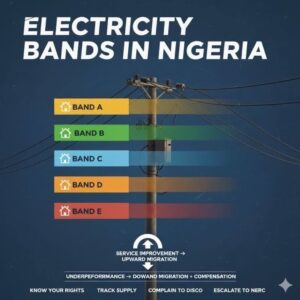
Following the announcement of subsidy removal in May 2023, the electricity band system was introduced.
The reality remains stark: despite increased electricity costs, consumers are not receiving equivalent value. This is sadly true even for Band A customers, who, despite tariff hikes exceeding 200% for promised premium service, continue to face unreliable power supplies across various regions of the country.
The 2023 Electricity Act Intervention: A Necessity Or Not?
Intended to disrupt the status quo, the 2023 Electricity Act marked a significant policy shift. The Act removed electricity from the Exclusive Legislative List, meaning States can now generate, transmit, and distribute their own power. It gave State governments the power to create and manage their own electricity markets, a move toward decentralisation that many hoped would unlock innovation and investment. And honestly, it’s a good idea. Yes, to healthy competition. Let states solve their own power problems instead of waiting on a fragile national system that has not been delivering for years.
But here is where it gets interesting: the Federal Government still controls transmission. So even if States generate power, they are still tied to a national grid that, quite frankly, is epileptic. It’s like upgrading your house wiring but still being connected to a shaky transformer down the street. The electricity issue is far from solved.
As of April 2026, 15 states, including Lagos, Edo, and Enugu, have obtained full regulatory oversight from the Nigerian Electricity Regulatory Commission (NERC), but citizens still cannot boast of an improved and consistent power supply.
The Continent’s Giant Sleeps in Darkness
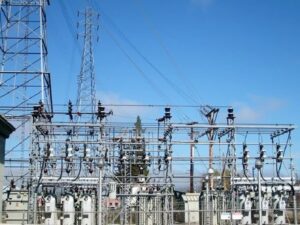
The lack of progress from 2023 to 2026 is deeply discouraging. Despite the passage of time, the national grid remains fragile and erratic, suffering from 22 collapses in 30 months. While Nigeria has an installed capacity exceeding 13,000 megawatts (MW), actual output typically ranges between 4,000 and 5,000 MW due to persistent gas shortages and deteriorating infrastructure.
In comparison to other African countries, we are lagging behind.
| Country | Population (Approx.) | Available Generation (MW) |
| Egypt | 111 Million | 37,000 MW |
| Ghana | 35.8 Million | 3,200 MW |
| Nigeria | 200 Million | 4,000 – 5,000 MW |
The power sector is also crippled by financial instability and is currently mired in a ₦6.8 trillion debt crisis. The situation reached a critical point in February 2026, when gas suppliers began withdrawing services due to non-payment, further dimming hopes for a steady power supply.
Power Sector Financial Overview (2023–2026)
| Fiscal Year | Budgeted Allocation (Capital/Recurrent) | Actual Releases / Expenditure Notes |
| 2023 | ₦239.50 billion | Execution was hindered by the transition of government; much of the actual was diverted to emergency grid repairs. |
| 2024 | ₦344.00 billion | Focused on the Presidential Power Initiative (Siemens project) and meter acquisition. |
| 2025 | ₦858.00 billion (Proposed Capital) | Significant Shortfall: In early 2026, NBET revealed that only ₦60 million had been released for the tariff gap by Q1 2026. |
| 2026 | ₦1.20 trillion (Subsidy Provision) | New Policy: The FG ended the Federal Residual subsidy. States now share the ₦1.2tn burden based on their local tariff mandates. |
Sources:
Consequently, citizens are increasingly abandoning the grid in favour of more dependable alternatives, such as solar power. Sad and, humorously, even the Presidency is pivoting with a ₦7 billion allocation to transition Aso Rock Villa to solar energy, underscoring the systemic lack of confidence in the national power supply. It seems Mr President has kissed his campaign promise and re-election bid to ensure stable electricity goodbye.
Policy vs reality
On paper, this administration’s reforms look impressive: higher revenues, new policies, decentralisation efforts. But on the ground and in reality, the story is different.
The former Minister of Power, Adebayo Adelabu, who resigned from office on April 22, 2026, to focus on his gubernatorial ambition in the upcoming Oyo state elections, claimed that during his tenure as Minister, peak electricity generation reached over 6,000 MW, up from approximately 4,000 MW when he took office. But in real time, that is not an achievement to be appraised; Nigeria, by now, should be able to generate reliably above 15,000 MW.
In addition to the claims by the former Minister, despite these peaks, Nigerians experienced multiple grid collapses during his tenure. If this is his scorecard for managing just one sector, should the great people of Oyo State really be considering him for governorship?
So where does that leave us?
The truth is, Nigeria’s power sector is somewhere in between progress and frustration. And from where I sit, we are closer to the frustration spectrum.
We’ve seen billions of dollars invested in electricity over many years, major handovers to private companies, and new laws like the 2023 Electricity Act. Yet, here we are in 2026, and the average Nigerian still struggles to get just eight hours of steady power supply.
If electricity is to truly power economic growth in Nigeria, then reforms must go beyond announcements and legislation. People need to feel the difference in their homes and businesses. That means serious investment in our infrastructure, better management across the board, and a real push to decentralise the system.
The success of Nigeria’s power sector would not be judged by new laws, but by whether a student in Ekiti or a shop owner in Kaduna can finally stop relying on a “I better pass my neighbour” generator and power banks. With fuel prices approaching N1500/Litre, there’s no better time to ensure Nigerians have a stable power supply, and the next administration must prioritise this.
Sources:
- The Vanguard Newspaper
- Bands classification, approved FX rate
- Nigerian Electricity Regulatory Commission
- Eko Electricity Distribution Company Tariff Plans
- NERC’s July 2025 Supplementary Order for Eko DisCo
Content provided by EiE Nigeria

Anjorin Desire is a Researcher and media personnel.